
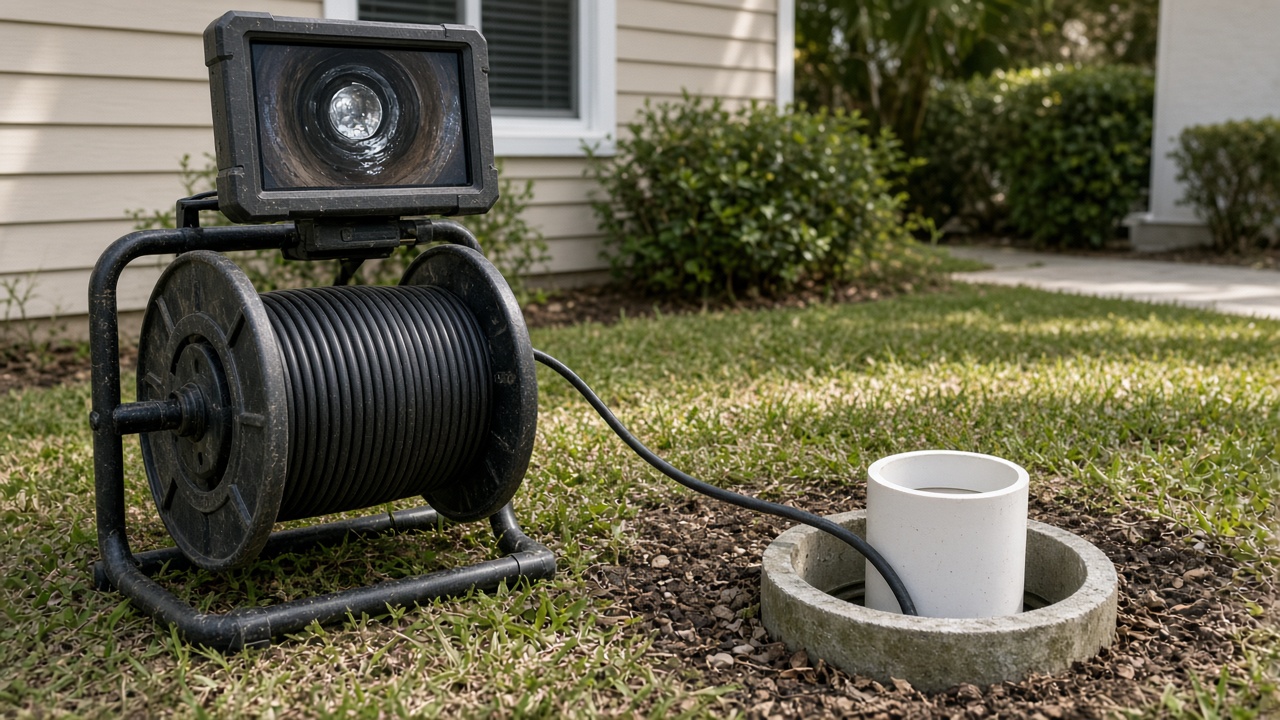
Clearing a drain without looking inside it is a bit like fixing a car by listening to the engine. Often you get the right answer. Sometimes you do not, and the money goes into the same repair twice. A sewer camera inspection takes the guessing out. A small waterproof camera on a flexible cable travels through the pipe and shows the technician, and you, exactly what is in there.
What a sewer camera inspection is
The equipment is simple in principle: a camera head with built-in lights, a push cable and a monitor. The cable is fed into the line through a cleanout or another access point, and the camera sends a live image back to the screen. Many cameras have a transmitter in the head, so a technician with a locator can trace the camera from above ground and mark where it is and how deep. Most systems can record video or capture stills.
Inspections are used on household drains, the main line and sometimes the line out to the street connection or septic tank. They do not need digging. They do need access, so a cleanout makes everything easier. If you do not know where yours is, the FAQ page explains how to find it.
When it makes sense to look
You do not need a camera for every clog. These are the situations in which one pays for itself:
- A repeat clog. The same drain has clogged more than once in a few months.
- A main line backup. Wastewater has come up in a floor drain, tub or shower.
- Slow drains throughout the house with no obvious cause.
- Before a major repair, so the work is based on what is actually in the line.
- When buying a home, particularly an older one, or one with mature trees near the sewer line. A buyer can ask a provider whether they offer a pre-purchase inspection.
- After roots have been cut, to confirm the result and see where they entered.
- When you smell sewage and cannot find the source.
- Before relining or trenchless work, to locate the problem.
If your drain is simply slow and has never been a problem before, try the basics first. See clogged drain repair.
What a camera can show
Roots. Fine hair-like roots at a joint, or a dense mass filling the pipe. See root intrusion removal.
Grease and scale. A pipe wall with a thick layer of build-up, which points to hydro jetting.
Cracks and breaks. Visible splits, missing sections or a collapsed pipe.
Offset joints. Pipe sections that have shifted and no longer line up, creating a ledge.
Bellies. A low spot where water collects in a pool. On camera, the water level rises ahead of the head and the image may go dark.
Foreign objects. Toys, wipes, tools, cloth and the occasional surprise that explains a sudden clog.
Pipe material. The type of pipe affects both cleaning methods and repair options.
Connections. Where branch lines join the main, and whether there is an accessible cleanout.
A camera does not tell everything. It cannot measure the exact slope or show what is happening outside the pipe. Where the picture is unclear, a provider should say so.
What happens during an inspection
- Cleaning first, if needed. If the line is full of water or debris, the technician usually clears it so the camera can see.
- Access. The cable is fed in through the cleanout. If none is accessible, a toilet may have to be pulled or a vent used.
- Traveling the line. The technician pushes the camera along while watching the monitor. They may stop at anything unusual and mark its position.
- Locating. If there is a problem, a locator marks the position above ground.
- Recording. Footage or screenshots are saved for you.
- Findings. You are told what was seen, what it means, and what the options are.
You are welcome to watch the monitor. Ask the technician to point out anything that is not clear.
What to ask the provider
- Will I get the video or screenshots?
- Is the inspection included in a clearing visit, or priced separately?
- How far into the line can you go?
- Can you locate and mark any problem from above ground?
- Will you give me a written summary?
- If you find damage, will I get a quote before any repair work begins?
A recording is useful to keep. A second provider can compare it with their own, and it supports any conversation with your insurer, your seller or your utility.
Getting ready for the visit
A little preparation saves time. Clear the area around the cleanout so the technician can reach it. If you know roughly where the line runs, mention it. Tell the provider about any earlier clogs, any repairs and the age of the home. If you are in a condominium or a managed community, check whether the line you want inspected is shared, since the association may need to approve access and may already hold recordings from earlier work.
What it costs
The provider sets the price. The factors are the length of line to be inspected, access, whether cleaning is needed first, the equipment used, locating work and the report. Some providers include a camera look with a clearing visit when the clog has been stubborn. Ask. The cost page offers a checklist for comparing quotes.
Using the findings
A camera inspection should end with a plain statement. Typical results and what follows from them:
- Clean pipe, no problem found. The clog was probably a one-off. You are done.
- Build-up on the wall. A cleaning pass, usually jetting, is the next step.
- Roots. Cutting and cleaning, and a repair discussion if they keep returning.
- Damaged or bellied pipe. A repair discussion. See sewer line repair.
- Unclear. A second pass, a different access point or another method.
If the proposed work is large, a second opinion with the recording in hand is reasonable. Nobody who is confident in their diagnosis should mind.
Serving Bonita Springs and nearby towns
This page is for Bonita Springs ZIP codes 34133, 34134, 34135 and 34136. Calls from Estero, Naples, Fort Myers, Cape Coral, Lehigh Acres and North Fort Myers can also be connected. Whether a given provider offers camera work for your property type is worth checking when you call.
Call now and ask about a camera inspection.
Ready to look inside your line?
Call now. Your call is connected to an independent local service provider who can talk through inspection options.