Most drain problems are clogs, and a clog is solved by clearing it. A sewer line repair is a different kind of job. It is needed when the pipe itself is damaged: cracked, broken, separated at a joint, sagging, or squeezed out of shape. Clearing the line in that situation helps for a while, and then the same trouble returns. This page explains how damage is found, what the usual repair options are, and what to ask before agreeing to any of them.
What the sewer line is
The sewer line, often called the main line or building drain, carries all wastewater from a house or small building out to where it connects with the public sewer or to a septic tank. It normally runs underground, sloping gently downhill so gravity moves everything along. The pipe near the house is the homeowner's responsibility; where the responsibility changes to the utility depends on the system and on where the property sits, so it is worth asking your provider and your utility.
In Bonita Springs, wastewater service in much of the city comes from Bonita Springs Utilities, a member-owned, not-for-profit utility, though some properties in the wider area are on other systems or on septic tanks. Which one serves you is worth checking before any repair, since it affects who is responsible for which section of pipe.
Signs of a damaged sewer line
- Repeated main line clogs, even after clearing
- Several drains slow at once, or the lowest drain backing up
- Gurgling from toilets and drains
- A sewer smell in the house, in the yard or around the cleanout
- Soggy ground, sinkholes or unusually lush grass along the line of the pipe
- Cracks in a slab floor or foundation near the drain lines (these have many causes, so this is a prompt to look, not a diagnosis)
- A camera inspection that shows a break, a bellied section, an offset joint or heavy root penetration
None of these is proof on its own. A camera inspection is how damage is confirmed.
Common types of sewer line damage
Cracks and breaks. Pipes can crack from ground movement, loads above them, age or poor installation. A crack lets water out and soil and roots in.
Offset or separated joints. Pipe sections are joined end to end. If the ground shifts, a joint can open or step, leaving a ledge that catches debris and an opening for roots.
Bellies and sags. A belly is a low spot where the pipe has settled. Water and solids collect in it and cause repeat clogs. A line with a belly may flow normally for a while and then clog in the same place.
Root damage. Roots enter through cracks and joints, then expand. Over time they can crack a pipe and fill it. See root intrusion removal.
Deterioration of old pipe. Older materials such as clay, cast iron and pitch-fiber (sometimes called Orangeburg) can degrade over decades. Newer homes mostly have plastic pipe, which resists many of these problems but is not immune to bad installation or settling.
How the damage is found
The usual path is simple. A provider clears the immediate clog, then sends a camera through the line. The camera shows the pipe's interior, and the technician can usually locate a problem by its distance from the access point or with a locator that detects the camera's transmitter from above ground. That tells you roughly how far from the house the issue sits and how deep. Ask whether the provider can give you a recording or screenshots. They are useful for comparing quotes, and for a seller or an insurer. The what a camera inspection shows post goes into more detail.
Repair options
The right repair depends on the type of damage, the depth, the location, what is above the pipe and the pipe material. A provider should explain the options plainly. In general:
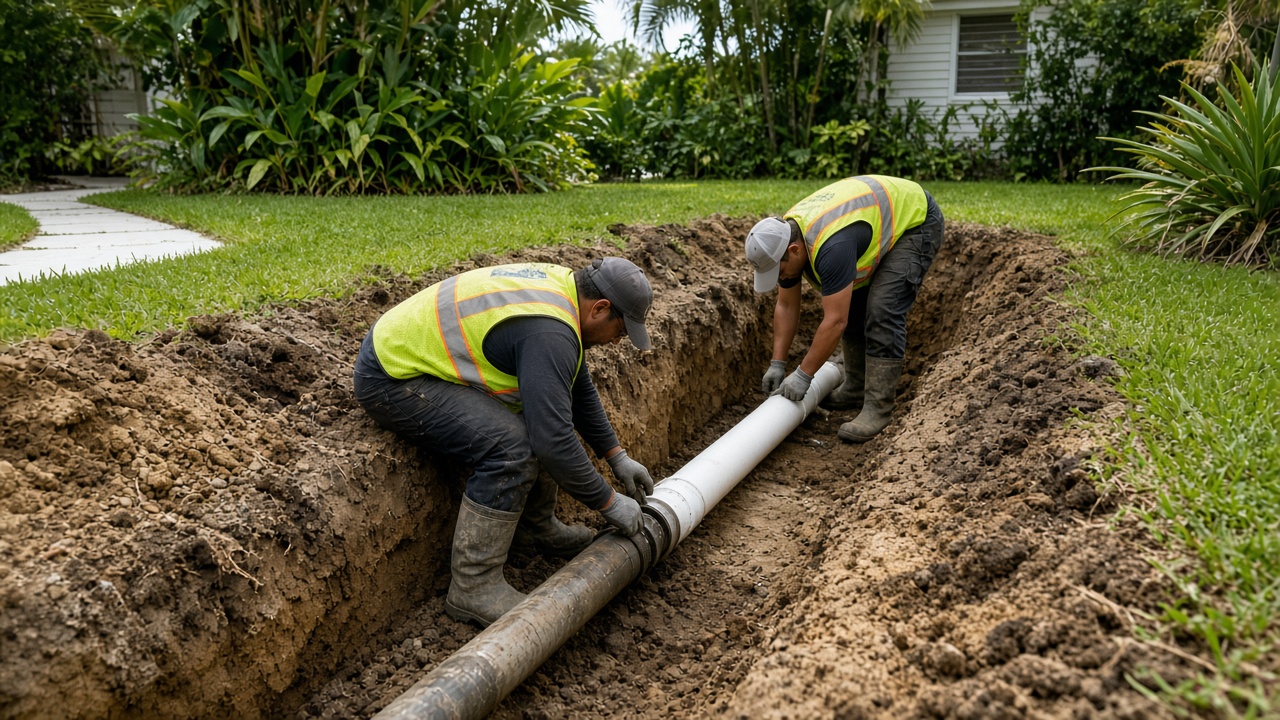
Spot repair (open trench). A short section is dug up and replaced. It suits a localized problem where the pipe is reachable. Concrete, landscaping and driveways in the way make it more involved.
Full replacement by open trench. The pipe is dug up and replaced along its length. It is the most disruptive, and in some cases the most appropriate, for severely collapsed or badly bellied lines.
Trenchless methods. Two main kinds are used. Pipe lining inserts a resin-saturated liner that hardens to form a new pipe inside the old one. Pipe bursting pulls a new pipe through the old path while breaking the old pipe apart. Both reduce digging. Neither suits every situation: a badly collapsed or heavily bellied line may need excavation instead.
Cleaning and monitoring. For a line with minor issues, a provider may suggest regular cleaning and a camera check at intervals instead of immediate repair. This is a judgment call and should be explained.
Ask the provider why they recommend the option they do, and what the alternatives would be.
Permits and the municipality
Sewer work often needs a permit, and the rules depend on where your property is. The City of Bonita Springs, Lee County, Collier County and the other local governments each have their own requirements. A provider who does this work regularly will know how the process works in your area. Ask who pulls the permit and whether its cost is in the quote.
Questions to ask before approving a repair
- What exactly is wrong, and where is it? Can I see the camera footage?
- What are the repair options and what does each involve?
- Why do you recommend this one?
- What will be dug up, and who restores the surface afterwards?
- Is a permit needed, and who handles it?
- Is the price in writing, and what could change it?
- What warranty applies to the repair, and what does it cover?
- What is your Florida license information? You can check it at MyFloridaLicense.com.
A second opinion is reasonable on any substantial repair. A camera recording makes that easy.
What affects the cost
The provider sets the price, and repair quotes vary more than cleaning quotes. The main factors are the length of pipe affected, depth, access, surface restoration, pipe material and diameter, the method chosen and permit fees. There is no fair standard number we can give you here. The cost page explains how to compare quotes.
Serving Bonita Springs and nearby towns
This page is written for Bonita Springs ZIP codes 34133, 34134, 34135 and 34136. Calls from Estero, Naples, Fort Myers, Cape Coral, Lehigh Acres and North Fort Myers can be connected too. Whether any one provider handles repair, as opposed to cleaning, is something to ask when you call.
Call now and say that you are asking about sewer line repair.
Ready to talk through a sewer line problem?
Call now. Your call is connected to an independent local service provider who can discuss inspection and repair options with you.