A sewer backup is the moment a drain problem stops being an inconvenience. Wastewater is coming back into the house, usually through the lowest drain it can find, and it is not something to mop up and forget. This page covers what to do in the first few minutes, what the drain-cleaning side of the response involves, and what to ask about cleaning up afterwards.
What a sewer backup is
Every fixture in a house drains into a network of branch lines, and those join the main line. If the main line is blocked, or the public sewer it connects to is overloaded or blocked, the wastewater has to go somewhere. It rises until it finds an opening: a floor drain, a shower or tub drain, a toilet, or a basement or utility room sink. Because the lowest opening is the first to overflow, a backup commonly appears in a shower, bathtub or floor drain before it shows up anywhere else.
Two broad situations cause most backups. In the first, the blockage is in your own line: grease, wipes, roots, a collapsed section. In the second, it is in the municipal or private system beyond your property line. A quick test helps tell the difference: if a neighbor is having the same problem, or the problem appeared right after a storm or an outage, the cause may be outside your property. Mention that when you call.
What to do in the first few minutes
- Stop using water. Do not flush, run the dishwasher or washing machine, or use showers and sinks. Every gallon you add has to go somewhere.
- Keep people and pets away from the water. Sewage can carry bacteria and viruses. Children, older adults and anyone with a weakened immune system should be kept away from the area.
- Turn off electricity in the affected area if water is near outlets or appliances and you can do so safely from a dry spot. Do not wade through standing water to reach a panel.
- Open windows for ventilation if it is safe to do so.
- Protect belongings. Lift items off the floor where you can, wearing waterproof gloves and boots. Leave porous items for later.
- Take photos and notes. Photograph the water, the affected areas and any damage. They help with providers and insurers.
- Call now. Describe what you see and which drains are affected.
Please do not pour chemical drain cleaner into a backed-up system. It will not clear a main line problem and it adds a hazard for the people who work on the line.
The drain-cleaning side of the response
A provider that clears backups typically does the following:
- Finds the blockage. The technician checks which fixtures are affected, locates the cleanout and decides where to start.
- Opens the line. A drum machine with a cutting head clears most main line stoppages. If the blockage is roots, a root cutter head may be used. See root intrusion removal.
- Cleans the line. Jetting may follow to remove grease and debris left behind. See hydro jetting.
- Inspects. A camera inspection shows the cause of the backup, and whether a repair is needed.
- Tests. Water is run through the system to make sure it flows freely.
The provider will often be able to tell you whether the blockage seems to be on your side of the property line or beyond it. If it is beyond, the municipal or private utility that operates the system is the one to contact, and the provider may suggest that you do so.
Cleaning up afterwards
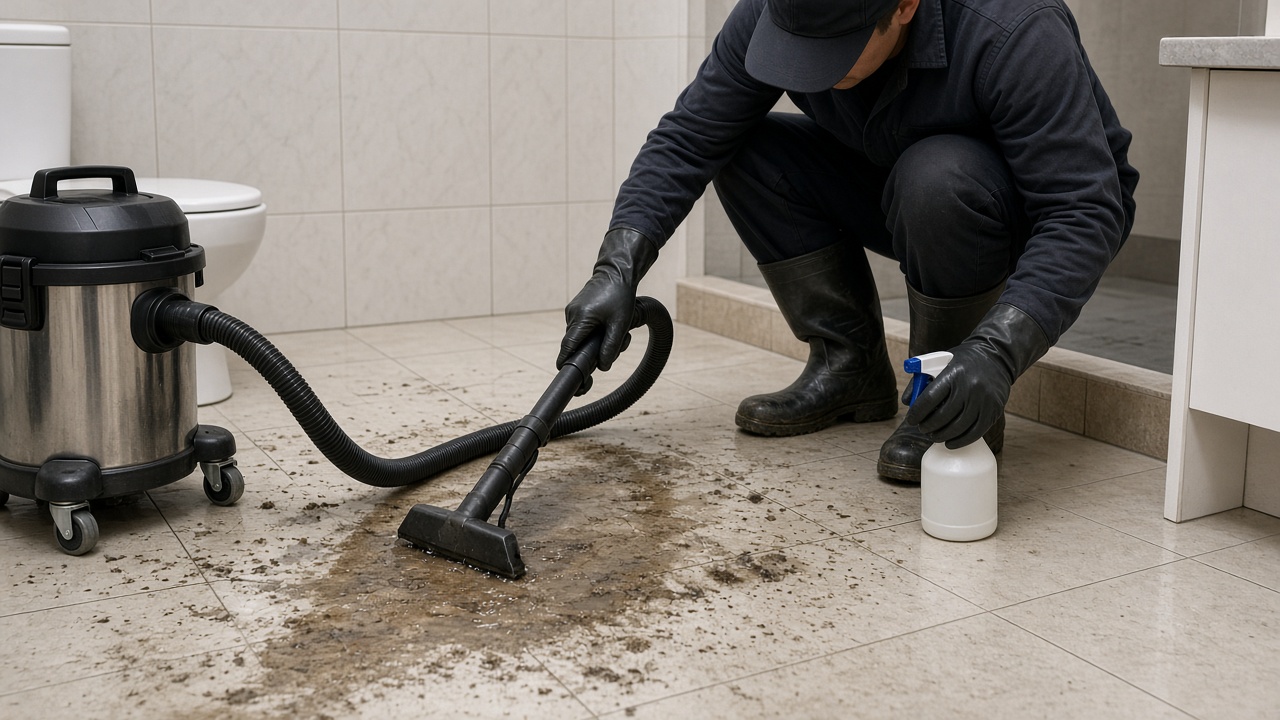
Clearing the line does not clean the house. Wastewater that has soaked into flooring, drywall, carpet or furniture can leave bacteria behind, and it needs proper cleaning and drying. Some providers of drain services do this work; others do not. Others specialize in cleanup and restoration. When you call, ask:
- Does your service include cleaning and sanitizing the affected area, or only clearing the line?
- If not, can you suggest what comes next?
Small spills on hard floors can be dealt with by the household using household cleaning products appropriate for the surface and wearing gloves. Larger areas, spills that have soaked into carpet or drywall, and any situation involving health concerns call for more careful handling. Public health guidance on sewage cleanup is published by federal and Florida health agencies, and it is worth reading before you start.
Insurance and documentation
Home insurance policies treat sewer backup very differently. Some exclude it entirely; others cover it through an endorsement or rider. Only your policy and your insurer can tell you. Before work begins, take photos, keep receipts and ask your insurer what they need from the provider, such as an invoice describing the cause and the work. Do not assume anything: call and ask.
Why backups happen in Southwest Florida
Local patterns are worth knowing. Heavy rainy-season storms can saturate the ground and put extra flow into sewer systems, and power outages can affect lift stations that move wastewater uphill. Neither is certain to affect a given street, but both are reasons a backup might not be your own line's fault. The post on why drains back up after heavy rain goes through the usual causes.
Closer to home, grease, wipes and roots cause most single-house backups, and homes that sit empty part of the year can have trouble when water use starts again after a long gap. See the main line clog page for the signs of an approaching main line problem.
Preventing the next one
- Keep grease, fats and food scraps out of the kitchen drain.
- Flush only toilet paper. Wipes, even the ones sold as flushable, do not belong.
- Know where your cleanout is, and keep it accessible.
- Ask a provider about a camera inspection if a backup has happened more than once.
- If roots are the problem, repair or cleaning on a schedule is better than waiting for the next backup. See sewer line repair.
Serving Bonita Springs and nearby towns
This page is written for Bonita Springs ZIP codes 34133, 34134, 34135 and 34136. Calls from Estero, Naples, Fort Myers, Cape Coral, Lehigh Acres and North Fort Myers can be connected too. Ask the provider about their response times and hours at the start of the call; we cannot promise them for the provider.
Call now and tell the person who answers that wastewater is coming up.
Need help with a sewer backup?
Call now. Your call is connected to an independent local service provider who can talk through the response with you.