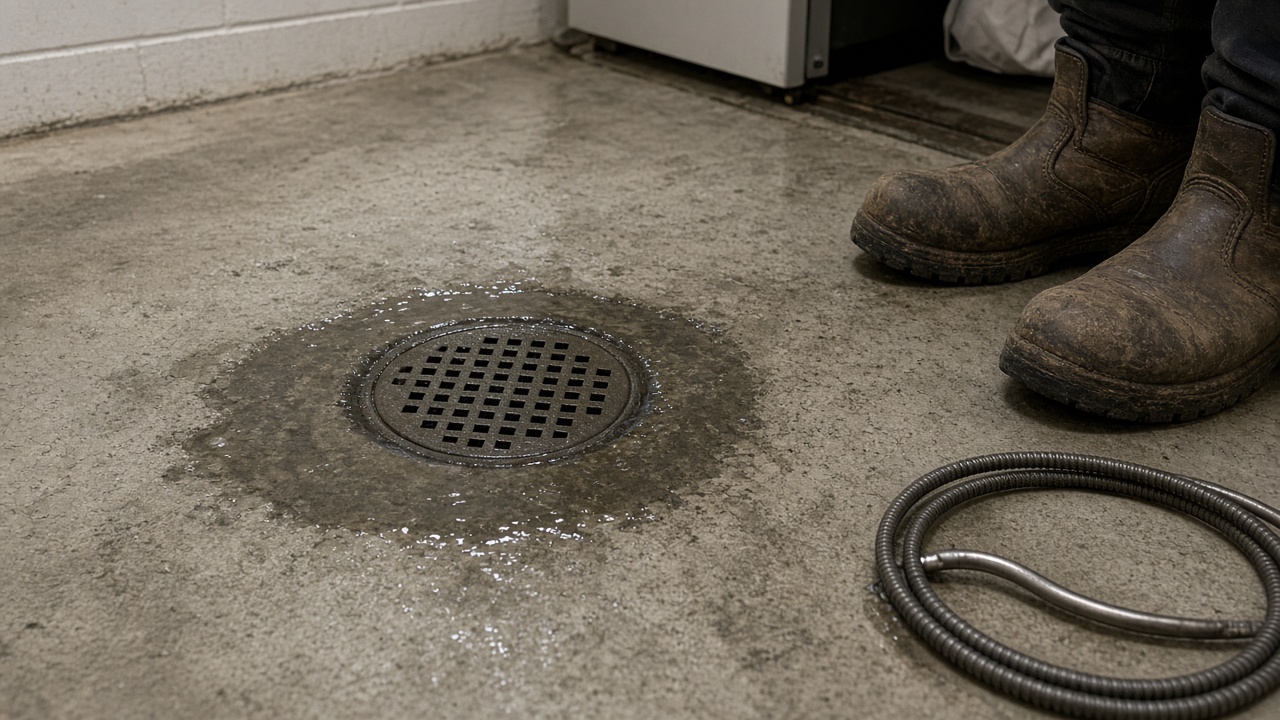
A floor drain is an unassuming fixture. Most of the time you do not notice it. When water appears around it, though, the cause is rarely the drain itself. A floor drain is usually connected to the lowest part of your plumbing system, which makes it an early warning light for problems further along. This page covers what floor drains are for, why they back up and what to do.
Where floor drains are found
In Southwest Florida, floor drains turn up in garages, utility and laundry rooms, mechanical rooms, and in commercial spaces such as kitchens, restrooms and storage areas. They are also common in condominium buildings, in the common spaces of managed communities and in pool equipment areas. Some drain to the sanitary sewer or septic system, while others lead to a separate storm or drainage path. Which one yours uses matters, because a drain that connects to the sewer can back up wastewater, while one that leads to stormwater behaves differently. If you do not know, a provider can often tell from the camera or by tracing the line.
Why a floor drain backs up
A main line clog. The usual cause, since floor drains connect to the lowest part of the system. See main line clog.
A blocked branch line. A clog in the line serving only that drain, from sediment, laundry lint, debris or a drain that has not been used in a long time.
A dry trap. Floor drains have traps, and in a rarely used drain the water evaporates. Without it, sewer gas can rise into the room. This causes a smell rather than a backup, and the fix is often just water.
Laundry discharge. Washing machines often drain into a standpipe tied to the same line as the floor drain. Lint and soap residue can build up.
Roots or a damaged line. A repeat floor drain backup can point to roots or damage below. See root intrusion removal and sewer line repair.
Problems beyond the property line. A blockage in a shared or public line may show up first in the lowest drain.
What to do first
- Stop using water. No laundry, dishwasher, showers or flushing.
- Keep people and pets away from the water. If wastewater is coming up, see the sewer backup page for the health precautions.
- Check for electrical risks. Do not stand in water near outlets or appliances.
- Move belongings off the floor.
- Check whether it is just a smell. If there is no water, pour a few cups of water down the drain and see if the smell improves.
- Take photos.
- Call now if water is coming up or the problem persists.
Smell without water
A floor drain that smells but has no water around it is often a dry trap. Pour a quart or so of water into the drain, wait a minute, and check again. In a drain that is seldom used, a small amount of mineral oil poured on the water surface after refilling slows evaporation, though not every provider recommends it, so ask if you want to try. If the smell remains after a refill, the problem may be a vent, a crack or a blockage, and it is worth a call.
What a provider usually does
- Identifies the drain. Is it a sanitary line, a storm line or a laundry standpipe?
- Checks other fixtures to decide whether the problem is local or in the main line.
- Clears the line with a cable or a small drum machine, usually through the floor drain itself or the cleanout.
- Uses jetting where there is sludge or lint build-up. See hydro jetting.
- Runs a camera where the problem repeats or the cause is unclear. See sewer camera inspection.
- Tests the system by running water through several fixtures at once.
Many floor drains have a removable strainer or grate. The provider may take it off to reach the trap, and it is worth checking that it was put back.
Condominiums, garages and shared spaces
A floor drain in a building garage or common area is often the association's responsibility. If you rent or own a unit, call the manager before booking work, since many buildings control access to shared lines. Tell the person who answers where the drain is, and whether other units are affected. For a business, say whether it is a commercial space; commercial drains, especially in kitchens, may take grease and need a different approach.
Preventing floor drain trouble
- Pour water down rarely used floor drains once a month.
- Keep laundry lint traps clean and use a lint filter on the washer hose if you have a standpipe.
- Keep the floor around the drain free of debris, soil and pool chemicals.
- Do not tip anything into a floor drain that you would not put down a sink.
- Know where your cleanout is.
- After a backup, arrange for a camera inspection to find the cause.
What affects the price
The provider sets the price. For floor drain work the factors include the type of drain, how far the blockage is, the access, the equipment and any camera work. Ask for the price before work starts. The cost page lists questions for comparing quotes.
Serving Bonita Springs and nearby towns
This page is written for Bonita Springs ZIP codes 34133, 34134, 34135 and 34136. Calls from Estero, Naples, Fort Myers, Cape Coral, Lehigh Acres and North Fort Myers can be connected too.
Call now and tell them it is a floor drain.
Ready to deal with the floor drain?
Call now. Your call is connected to an independent local service provider who can talk through the problem.